

The ability to focus is one of the greatest tools we have on our spiritual journeys. It is a complete and total necessity to higher attainments in our physical realm and our inner world. We must do everything we can to cultivate this ability, and as you will likely notice immediately upon setting out on this task, our modern world is built upon the normalization of distraction.
Few take the time to notice their failures of focus. It can feel productive to be scattered; the taking in of information can feel productive. And it is, to a certain point. But informational overload is counterproductive and leads to stagnation or over-intellectualism which will halt any real growth. Worthy are those who cultivate the ability to recognize and take meaningful action.
The success metric is simple: physical, tangible, real-world results. Does your frenetic thinking lead to action, or does it remain in the realm of the mind? Focus and concentration are the engine, the drivers of daily execution of meaningful actions.
When we set out on the spiritual path, we should begin with a daily meditation practice, a tool which asks us to be single-minded in our efforts. Here is where we must apply the skills of focus and consistency. The serious seeker will almost immediately find that they are distracted and unfocused when attempting meditation. This is a good thing and a sign of progress, for without the realization that one is not focused, one cannot become focused. It is always the conscious recognition of what we are not that leads to the ability to become that which we desire to embody.
We should not enter into spiritual practice as an escape from reality, but rather as a way to become even more aware of reality. If we enter into the consistency of a focused spiritual tradition with the goal of seeing rather than feeling “better” – all truths will eventually be revealed to us. As we work with and through the animal nature inherent in humanity, divinity begins to reveal itself. We become worthy of this witnessing through our commitment to “seeing.”
We should seek to open our eyes, to awaken. If we enter into an established spiritual tradition with this mindset, even those religions which have been coated and lacquered with half-truths and literalism (and coded to conceal Divine Truth as a means of controlling the masses) we will eventually be awakened to Divine Truth. This is because we all have an inner thread that connects us to the Divine, and this thread will begin to vibrate and seek resonance with its counterparts when we make this mindset shift. But we must be willing to seek Truth above comfort, and self-sovereignty over the perceived safety of the hive mind. This is the way it must be done in the modern sea of willful ignorance and weaponized distraction.
One very beautiful aspect of this path is that actual truth will lead to unexpected places, which is a testament to the fact that our rational minds struggle with the perception of truth. This is because the mind is accustomed to preserving our sense of self, or ego, which is a necessary component of becoming a self-realized individual. However, the mundane ego can cloud our ability to perceive truth, as it is fundamentally a self-preserving mechanism. The deeper and more mystical aspects of life require a calculated abandonment of rationality, and this is where we meet Divinity.
True and worthwhile spiritual practice will almost always be unsettling at first. I make this distinction because not all spiritual practice is pure enough to make any difference whatsoever in the lives of its practitioners. Some practices instead seek to comfort and lull the individual into a deeper state of sleep, offering a narrative in which someone else has made a sacrifice on their behalf and thus they are “saved.” Happiness and peace are neither the immediate result nor the goal of rigorous, catalytic, and truly transformative practices. And again, that is a good thing.
We do not come to Earth fully formed and flawless; we come to perfect ourselves through life experience. How can one perfect oneself if one does not see the flaws? When we enter spiritual practice with the mission to detect our flaws, we have found the true path. A proper spiritual practice is a luminous, truth-serving, emotionless mirror. When we embrace this, we clear our channels so that we might become a conduit for divine light. We become the perfected surface upon which divine light can reflect.
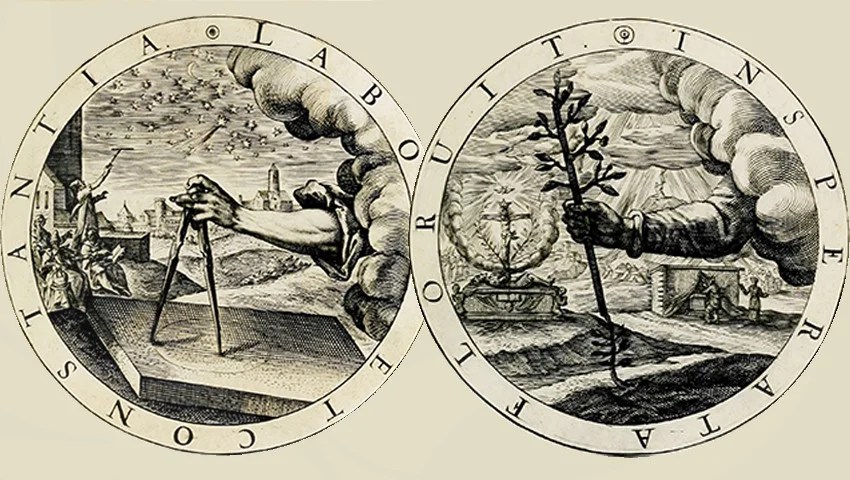
Through “hard work and perseverance” it “blossoms unexpectedly.” This is written in Latin on these emblems. They are #9 and #59 from the book “Selectorum Emblematum” by the German poet Gabriel Rollenhagen.
When we enter spiritual practice to “feel better” or “find peace,” this is usually a trap, as the common interpretation of these words often amounts to covering over what is unsettled underneath. It is a glossing over of the work required to create true change within one’s body, soul, and perception.
Seek not this glossy covering.
Seek instead the consistent work and focus required to build inner strength that will eventually lead to spiritual transformation. Take the long way. Take the difficult path. Take the path of real and total obliteration of all internal weakness. We must not seek to paint ourselves with the coverings of religion, virtue signaling, or the outward appearances of peace. We must enter deeply and profoundly into the self. We must tie, or “yoke,” ourselves to spiritual practices that are harsh and reveal our true reflection. Then, and only then, are we capable of the change necessary to align ourselves with our true will and Divine Will.
Here is where peace is eventually achieved. It is not through the acceptance of flaw, but through its eradication. This distinction is enormous. The proper path transforms that which is dull into that which shines. We should be unsettled by mediocrity, and to accept our flaws under the guise of inner peace is a waste of human potential.
In the end, we must face ourselves. Until we do, anything we attempt will simply be an external projection of our flaws, embodied as emotions and reactions to “triggers,” which prove that we are neither self-possessed nor self-controlled. The ego will do anything to avoid facing itself, and this is why the sincere seeker eventually employs the steady mechanism of spiritual practice. Self-focus ultimately meets its divine core, and that is the point at which individuality merges with Divine Will, allowing us to discern and define our unique destinies.





 VALERIE CODY