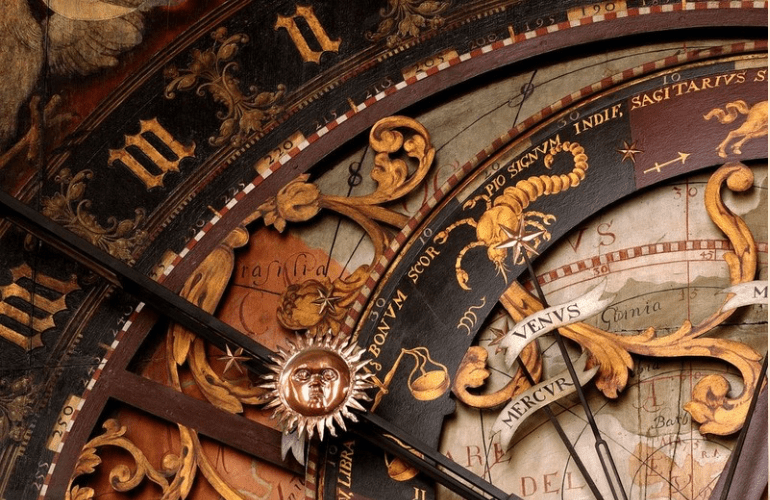

The documenting of the passage of time is one of the most intricate and important of the ancient mysteries. This is due to the fact that methods of keeping rhythmic and cyclical time over large spans such as centuries and millennia were esoteric practices neither meant for nor shared with the masses. These were “behind the scenes” actions that informed outward practices such as yearly religious rites – but the calculation, formulation, and dispensation of time-keeping was implemented by the ruling classes.
The ruling classes set the calendar year after year, as seen in the creation of tools such as the Gregorian and Julian calendars. We see interest-piquing nuances such as leap year and the beginning of the calendar year falling in winter rather than spring, as nature would dictate. When we peer, even for a moment, into these oddities, the mysteries of time-keeping begin to reveal themselves to the curious and spiritually minded individual.
However, these truths were not meant to be observed or examined by the commoner. They were meant to be blindly celebrated in public mass rituals so that certain traditions, especially agricultural ones, could be maintained. Such as the celebration of the ancient Roman holiday of Ceraelia in the spring, which denoted it was time to plant seeds in the ground. If seeds were not planted at the correct time, the harvest would not beat the frost in later months, and the food supply would be shortened. Thus, it was in the interest of the time-keepers to let the masses in on certain mysteries that ultimately benefited the aristocracy.
In Greek thought, primordial time was personified as the figure Chronos, from which we get the term chronological, meaning “of a record of events starting with the earliest and following the order in which they occurred.” This figure, Chronos, emerges at the beginning of all things, pre-dating calendars and even pre-dating seasons and agriculture. In later philosophical and symbolic traditions, Chronos becomes intertwined with the Titan Kronos and is depicted as devouring all things, a symbolic expression of the idea that nothing escapes duration. Everything that arises within time is eventually dissolved by it. The image of time consuming its own creations reflects an ancient recognition that creation and decay are inseparable. Time gives form, and time reclaims it.
As this lineage moved forward into the modern world, time was increasingly abstracted and compressed into mechanical measurement. Clock time became a regulated system of hours and minutes, severed from celestial observation and seasonal rhythm. What was once an intimate relationship with cycles of growth, decay, and return became a quantified structure imposed upon daily life. In this way, modern clock time can be understood as a spiritual narrowing of Chronos, a reduction of infinite duration into manageable units, useful for organization, yet often disconnected from the deeper rhythms that once governed human life.
Divine timing is perfect, but our human methods are simply a workaround to understand the cycles of the divine, which we attempt to quantify as time. Our methods are imperfect. This is why we have leap years, daylight savings time, and why ruling entities of the past such as Pope Gregory XIII and Julius Caesar introduced certain calendars, the Gregorian and the Julian, respectively.
The Julian Calendar was an imperial time-keeping tool introduced by Julius Caesar in 45 BCE. This is a solar calendar, which would not surprise anyone who has realized that the Bible itself is a solar book, keeping the cycles and mythologies of the sun, humanized for mythological reasons as a “son of God.” This calendar was a way to impose order, unity of expectations, and ultimately control upon the growing Roman Empire.
The core features of this calendar were a 365 day cycle with holy days, shortened to the colloquial word “holidays,” celebrated at astrological and astronomical points, and a leap year that added an extra day every four years.
To fully understand the reasoning behind this solar time-keeping method, one must understand the apparent path of the sun’s yearly cycle. In our modern era, the twelve signs of the zodiac have been mocked into the ground. They have been bastardized and ridiculed by the masses to the point of extreme parody at best, and demonized (literally) by the church itself – even though the church’s actual mechanism of keeping its sacred holidays such as Easter and Christmas is astronomical and astrological in nature.
The sun takes 365.2422 days to complete its yearly cycle around the ecliptic. The ecliptic is the band of twelve constellations that make up the zodiac wheel and are marked through the months of the year. This emphasis on twelve appears repeatedly in myth, a theme explored in my post on the Eternal Legend: here. This is known as the solar year and is what modern calendars use to track time, with the sun as the marker. Keep in mind that while we are using Earth’s relationship to this particular luminary – other planets mark time in their own cycles, which is why we observe astronomical phenomena such as retrogrades and “returns.” Again, the ruling classes rely on the social degradation of these very real events to keep the masses from understanding the underlying cycles that govern physical reality.
Back to the Julian Calendar.
Because this precise decimal calculation needed to be rounded so it could be applied to daily life, this calendar settled on a fixed point of 365.25 days in a solar year. This minute inaccuracy accumulated, and the calendar became imperfect to the point of outward flaw. It was off by one full day every 128 years.
Enter Pope Gregory XIII in 1582 with the Gregorian Calendar, which is still in use today.
If we look carefully here, two secrets are revealed at once. First, the tracking of time is controlled by the aristocracy, papacy, and emperors via royal decree. Second, and most importantly, religious holy days are astronomical and astrological.

By 1582, the pope and religious authorities recognized that the holiday commemorating their risen savior, Easter, had drifted about ten days from its original equinoctial set point. This was due to the imperfection of the Julian Calendar and its accumulated error. As a correction, ten days were skipped and leap years became more selective, and so the Gregorian Calendar was imposed upon society.
The church saw it as critically important to ensure that Easter remained aligned with its astronomical markers, which are: the first Sunday after the first full moon following the spring equinox. This alone should prompt the serious truth seeker to look further into the mysteries of religion. If the rising of a dead savior occurred on a specific day, celestial positioning should be irrelevant, and yet it is not. A scholarly and inquisitive examination of Christian holidays reveals the astronomical and astrological foundations beneath the myths of the church.
The idea that masterful astronomical time-keeping functioned as an arm of the elite is still intact today. We can observe this subtly through the emphasis on expensive timepieces as status symbols. This very real signification extends further to considering that one of the richest men on the planet, Jeff Bezos, is funding a forty-two million dollar monolithic clock in the Sierra Diablo mountain range in West Texas known as the 10,000 Year Clock.
The tracking and control of the collective perception of time has historically been the realm of the elite, but this does not mean that everyone must remain within its grip. Through contemplation and understanding, one can transcend these imposed frameworks. With a sincere connection to inner truth, we may orient ourselves into a more conscious relationship with time, which should be a goal of every true and meaningful spiritual practice.


 VALERIE CODY