
A diptych is a two-sided altarpiece. One side depicts a deity or sacred scene, the other presents something more earthly, such as a self-portrait, an ancestor, or an influential figure like a patriarch or monarch. The two panels are bound together by a hinge or spine, much like a book or a locket. Historically, diptychs (unlike the larger triptychs used for liturgical altars) were placed upon personal shrines within the home. During the late Medieval Ages and the early Renaissance era especially, commissioning a “donor portrait” diptych was common. These works of art represent, whether consciously or subconsciously, the seeker’s desire to fuse with the Divine.

The Wilton Diptych, c. 1395-1399, displayed at the National Gallery in London. Commissioned by and depicting King Richard the 2nd on the left, and the Virgin with Child on the right.
The hinge of the diptych is both utilitarian and symbolic. Outwardly it’s just a joint, but symbolically it represents the “axis mundi.” It is the same motif we see in myths of a central pillar where heaven and earth meet. Specifically, I will be exploring the Nordic myth of Odin and the tree Yggdrasil below. In esoteric anatomy, this axis is the human spine: The subtle corridor where instinct can be transformed into insight and the Divine descends into form.
Placing a diptych on an altar is a physical reenactment of an inner reality. One side shows the Divine, the other the human, and the hinge becomes the meeting-point between them. It is the place where consciousness can move upward or downward without severing itself from the body. Like the nervous system itself, the “hinge” keeps us anchored while we reach upward. It prevents the seeker from dissolving entirely into transcendence, and instead supports the weaving of the heavenly and the earthly. The diptych becomes a symbolic mirror of this inner ascent, showing how human consciousness joins with Divine consciousness through a shared axis. This movement is an internal anointing: a rising, consecrating current within the subtle body.
Exoteric religions echo this inner process through outward sacraments. In Catholicism, a consecrated oil is placed on the forehead of worshippers as a sign of blessing. This is a symbolic reflection of an esoteric secret that happens within. The “inner oil” is a subtle essence recognized across spiritual traditions, it gathers and rises through the spinal channel, enlivening centers of perception as it ascends.
Even the Catholic term “chrism” reveals this esoteric heritage: it is related to Christos, “the anointed one,” and literally translates to “oil.” What is enacted externally as ritual anointing is a representation of the inner refinement and elevation of one’s own subtle essence.
It is the sacred elixir:
- the milk-and-honey fluid of the mystics
- the Shekhinah descending and rising
- the serpent-fire of the yogis
- the pneuma carried up the ladder of Jacob’s dream
As the internal chrism rises, it anoints the brain (the inner temple) and opens the higher centers of vision and gnosis. This is how the seeker moves from belief to knowledge, from worship to union. Thus, the spine is the metaphysical hinge through which human consciousness weaves itself with Divine Will.
This ascent is the basis of many mythological journeys. For example, in the Nordic myth of Odin and Yggdrasil, Odin sacrifices himself by hanging himself upside down on the tree (named Yggdrasil) for nine nights. He does this so that he may gain the knowledge of the Nordic Runes. The understanding is that in order to properly intuit Divine knowledge (rather than be spun off into delusion), one must purify themselves. This myth is a good example of the internal annointing because Odin is hanging upside down, which mimicks the act of raising of the inner chrism.
The “Ascent Myth” follows this pattern:
- A lower world: Ordinary consciousness, instinct, matter
- A middle journey: Trials, purification, initiation
- A pinnacle or summit: Revelation, union with the divine
- A return: The enlightened hero re-enters the world transformed
This motif mirrors the movement of energy up the spine, from lower instincts to higher perception and finally to Divine union. The spine has 33 embryonic vertebrae, which alludes to why this number is used in certain fraternities to denote a “rise” in rank amongst one’s fellows.
The Feminine and The Masculine
Although the ascent of the chrism is a universal mechanism, the masculine and feminine bodies conduct this ascent in different ways. These differences are not oppositional but complementary expressions of the same spiritual physics. This is why we see symbolism in the form of the sun/moon or fire/water.
In the masculine form, the generative essence gathers like pressure. It behaves alchemically like steam building within a sealed vessel: focused, upward-driving, and linear. This is why Hermetic texts describe the masculine path as the “fire rising.” It is the solar current that pushes toward illumination through intensity and disciplined direction. When conserved and sublimated, this pressure moves through the spinal axis as a concentrated surge.
In the feminine form, the same essence does not accumulate as pressure but diffuses as luminosity. It spreads through the subtle body like light filling a chamber, illuminating her inner space before rising higher. The feminine stores life‑force in a more distributed, oceanic way; therefore, her spiritual ascent is not a push but a glow. It brightens the womb, the heart, and the imaginal centers before lifting toward the crown. The internal tide of intuition rises not through force but through fullness. Women are inherently generative and naturally retain more essence; because of this, she can often achieve this ascent without the same strict conservation required of a male aspirant. The ascent can feel spontaneous, almost trancelike, as she channels connections, ideas, or inspiration for art and poetry (her unique interests are a reflection of her own personal essence, genetic inheritances, and Will) — manifesting works that seem to emerge from a source larger than herself, flowing naturally from the wellspring of her preserved essence.
When this life-force is preserved (through purity of input, rest, love, intention, lowered overstimulation), its substance becomes the raw material of inspiration itself. It refines into completely unique ideas, concepts, inventions, and art. These creations are as singular and unique as a fingerprint. This is because the same generative essence that produces physical life (via pregnancy), when redirected inward, produces physical rejuvenation, as well as psychic, intellectual, and spiritual life. The life-giving essence is the same; only the direction changes.
The diptych is a medieval spiritual device and its impact depends on how it is used. Through spiritual fidelity and consistency, we invite the Divine to enter and reshape our awareness. With pure intention, even the most modest object can reveal profound treasures to the worthy, truth-loving aspirant. When regarded merely as decoration, it may yield only ephemeral wisps of wisdom. When viewed as a symbol of our desire to weave our consciousness with the Divine, the diptych can inspire devotion to our internal ascent.
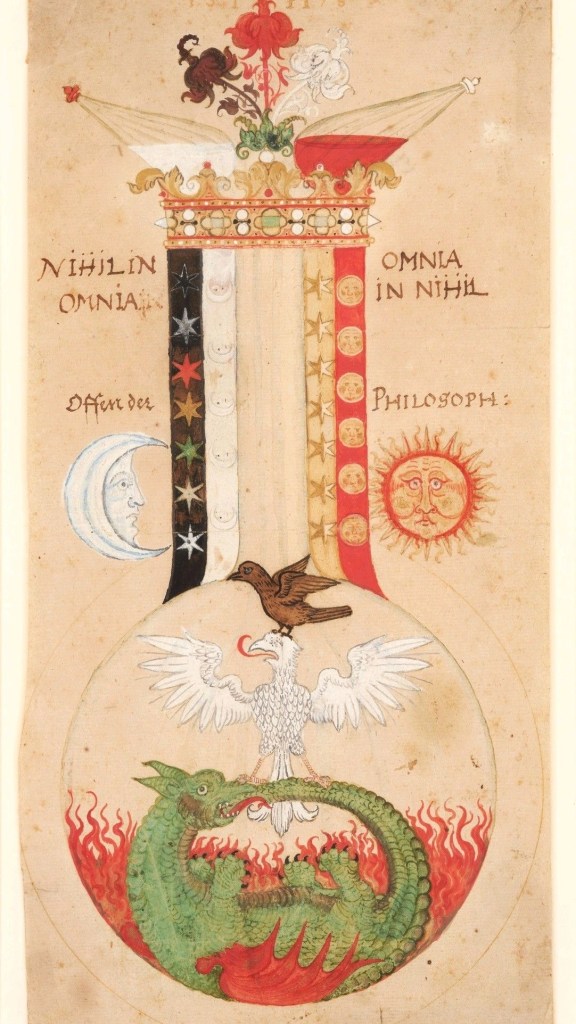
A page from the Aurora Consurgens, a Medieval alchemical manuscript. It uses visual symbolism to convey this mystery.
Your message has been sent

 VALERIE CODY
[…] The reason these two are ultimately one and the same is because the key itself is what I will call the Eternal Legend. Once this reality is recognized, its fragments begin to align effortlessly with the allegories embedded in our time-tested myths. We can observe this, for example, in the ancient alchemical legend of “turning lead into gold.” Within this vast, intricate, and beautifully orchestrated narrative, the alchemical laboratory is the human body itself, and the beakers and chemical reactions symbolize internal processes of transformation. Each element within each legend functions as a key, revealing the Eternal Legend – ready to be accessed by the conscious and spiritually attuned individual. I wrote more explicitly about this Eternal Legend: here. […]
LikeLike